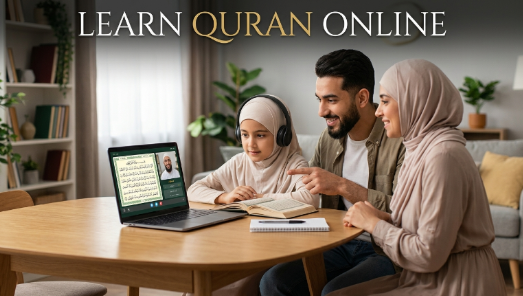
Thanks to digital classrooms, studying the Quran no longer depends on where you live or how packed your schedule is. Anyone, a curious beginner or a student aiming to go deeper, can now build a real relationship with the text from a laptop or phone. This guide walks through what online Quran study actually involves, how the learning path unfolds stage by stage, and what to look for before you commit to an academy.
What Does Studying the Quran Online Actually Look Like?
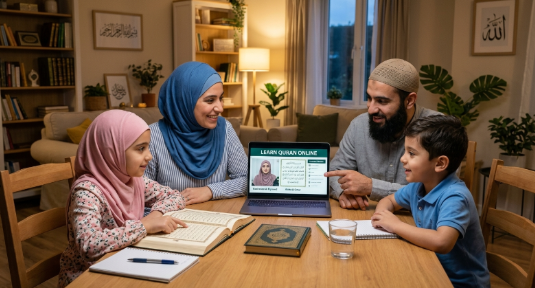
At its core, it means pairing up with a trained teacher over video calls, working through recorded material, and using digital tools to practice, all without setting foot in a physical classroom. You need a device, an internet connection, and a willingness to show up consistently. For students living far from an established mosque or Islamic center, or those who simply can’t fit a commute into their week, this format opens a door that used to be closed.
A good program does more than hand you a video call link. It pairs you with a certified instructor and moves you through reading, correct pronunciation, memorization, and meaning, usually along a defined curriculum that carries you from your very first Arabic letter to fluent, confident recitation. The real advantage isn’t just convenience; it’s getting one-on-one coaching that adapts to how you personally learn.
Quran Bliss Academy’s Course Lineup
Quran Bliss Academy runs five separate tracks, each built for a different point in a student’s journey, from someone who’s never opened a Quran before to scholars pursuing specialized certification.
Built for absolute beginners, this course lays down the groundwork: Arabic letters and how to say them correctly.
- All 28 Arabic letters and their correct pronunciation
- How letter shapes shift depending on their position in a word
- The basic vowel marks (Harakat)
- Reading simple words and short phrases
- A solid base for tackling Quranic text
- A realistic timeline of 4–6 weeks with regular practice
For students who already read comfortably and are ready to sharpen how they recite.
- Applying Tajweed rules in live recitation, not just in theory
- Makharij, where each letter’s sound comes from
- Sifat, the qualities that distinguish one letter from another
- Correct vowel elongation (Madd) and how letters connect
- Direct application of these rules to actual Quranic verses
- Live, real-time correction as you practice
- A path to confident, fluent recitation
- A typical timeline of 12–16 weeks
Designed for students ready to commit chapters, or the entire Quran, to memory, with proper Tajweed built in.
- A memorization plan tailored to your personal goals
- Daily targets paired with a structured revision schedule
- Tajweed applied throughout the memorization process
- Retention techniques that actually reduce forgetting
- Regular check-ins to confirm accuracy
- A gradual climb from short Surahs to the longer chapters
- The option to pursue Ijazah certification once the Quran is complete
The most advanced track on offer, aimed at students seeking formal authorization to teach.
- Recitation and memorization polished to the highest standard
- An officially recognized Ijazah certificate
- A thorough assessment process with teacher verification
- Advanced Tajweed refinement under close supervision
- Direct mentorship from certified scholars
- Authorization to teach Quran recitation to others
- A stronger grasp of both theory and practical recitation
- Entry into a long, unbroken chain of Islamic scholarship
A specialized track for advanced students and scholars interested in the ten recognized methods of Quranic recitation.
- The ten authentic Qira’at recognized across Islamic scholarship
- The historical background behind each recitation method
- Practical differences between the various Qira’at
- Fine-grained pronunciation nuances specific to each style
- Stronger overall Tajweed and recitation precision
- Guidance tailored specifically to advanced learners
- A deeper appreciation for the range within Quranic recitation tradition
The Learning Journey, Stage by Stage
Progress tends to follow a fairly predictable arc:
Step 1: The alphabet. Most students start with something like the Noorani Qaida, which walks through letter shapes, sounds, and how letters connect to each other. With daily practice, this usually takes two to four weeks.
Step 2: First reading attempts. Next comes reading short words and simple verses, which builds comfort with how Quranic text is put together. Expect this phase to run four to eight weeks.
Step 3: Tajweed fundamentals. Here you learn the rules that govern correct pronunciation, including Makharij (exactly where each letter’s sound originates in the mouth and throat) and Sifat (the distinguishing qualities of each letter). Getting a solid grip on this typically takes six to twelve weeks.
Step 4: Fluency through repetition. Fifteen to thirty minutes of daily reading, sustained over eight to sixteen weeks, is what turns effortful decoding into smooth, confident recitation.
Step 5: Memorization and meaning. Once reading feels natural, students begin memorizing chapters while learning what they mean, this is where the spiritual connection tends to deepen
What to Look for in an Online Quran Academy?
A few factors make the difference between a program that works and one that doesn’t.
- Teacher credentials: Confirm the instructors are qualified in Tajweed and Quranic studies. Ijazah-certified teachers, meaning they carry formal authorization to teach, are a strong signal, as is a track record of years teaching and students who’ve actually progressed.
- A defined curriculum: The course should move through clear stages, from beginner to advanced, with real milestones along the way.
- Scheduling that fits your life: You should be able to pick lesson times that work with your routine, not the other way around.
- Tools that support real practice: Virtual whiteboards, clear audio for pronunciation demonstration, and the ability to record and revisit lessons all matter.
- Ongoing progress tracking: Look for regular assessments, specific feedback on your recitation, and written updates on where you stand.
- Clear, honest pricing. Fees should be stated upfront, ideally with a free trial lesson before you commit to anything.
Quran Bliss Academy is built around exactly these principles, combining traditional teaching methods with modern tools, in a way that respects each student’s pace and circumstances.
Getting Started, Step by Step
- Know where you stand. Are you starting from zero, or do you already have some Arabic background?
- Look into a few academies. Check teacher credentials, read what past students say, and confirm any Ijazah claims.
- Take a trial lesson. A free session tells you more about teaching quality than any webpage can.
- Pick the right track. Foundation for beginners, Tajweed for intermediate students, Memorization for advanced learners, or Ijazah for certification.
- Show up consistently. Twenty to thirty minutes a day, with regular lessons, is what actually moves the needle.
Frequently Asked Questions:
Is online learning realistic for adults?
Very much so. Online classes work for every age group, and many adult students reach conversational fluency within six to twelve months.
Can older adults still memorize the Quran?
Yes. With consistency and the right guidance, memorization is achievable at essentially any age.
Are online Tajweed teachers as effective as in-person ones?
Yes, live instruction with real-time correction makes online teaching genuinely effective for mastering pronunciation.